Skip to content

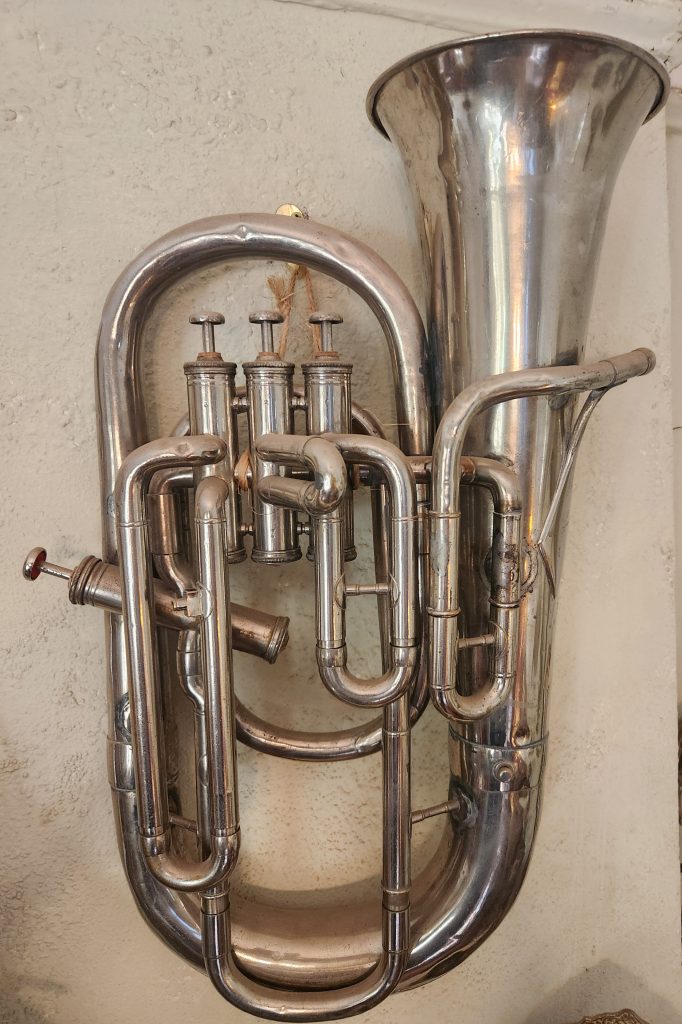
Perhaps a Ballad Horn?

Here’s an interesting horn. It seems essentially a baritone or euphonium, but pitched in ‘C’, a step higher than a modern instrument; looks like a modern 4 valve horn, but a trifle smaller, as one might expect from the higher pitch. The bell is quite small, by modern tastes, with a large throat, and the tubing is conical throughout. Its sound is similar to my ‘C’ ophiclyde, which is also quite conical, with a similar size bell – quite mellow, but lacking darkness.

Engraved on the bill is Kandowsky, 74 Rue de Cirche, Paris – I gather a large retail shop, stamping its name on instruments from other contract manufacturers. In the day, there were numerous, quite good, factories in both France and Bohemia. Many Lyon and Healy brass instruments from the period were sourced from both regions.

It’s ‘C’ pitch allows it to be played along with a piano, reading the melody line over the pianist’s shoulder, without transposing – exactly like a C-melody sax. Horns produced with this in mind, around 1900, were often sold as “ballad horns”, but they were never curled similar to a euphonium. They were generally circular, like a mellophone or coach horn (at least from what I’ve seen).

Regardless, a neat horn, and a fine player, though not with a full modern euphonium sound. Not a tremendous amount of wear (the valves are quite tight), but it had taken a pretty severe hit, and been sloppily put back together using lead solder and square nails to replace some braces. Cost me more to put the poor thing to rights than it cost me to buy.

Need Military Hardware?

We’ve seen concern of late regarding re-building America’s military, though little appreciation on the varied difficulties of doing so, quickly.

I joined my extended family on Thanksgiving at my little sister’s, up the road in Flagstaff.  Her husband, Jim, until recently co-owned a mini-storage facility, and thereby accumulated quite a trove of miscellany from abandoned units.  Knowing my interest in history, he graciously (maliciously?) presented me a 1920’s era Swedish army helmet – and a link to the history of its development and eventual production:

https://www.world-war-helmets.com/fiche/Casque-Suedois-Mle-21-High (might have to copy and paste)

Note the time needed, and the complexity, of designing and producing something as straightforward as a helmet.  Consider how long it might take us to, say, produce a reasonable number of frigates to fend off, say, China.

Might be a while, this military re-building.


1929 Mother-in-law special, bathroom

The 1929 mother-in-law addition included a bathroom with a large tiled-n shower.  Wall tile and flooring was original; I installed a pedestal sink and toilet with a hang-on-the-wall tank, both scrounged; the toilet came from a soon to be demolished turn of the century boarding house in downtown Phoenix.  I hand-crafted a tank top to replace the absent one.  Shower and sink hardware, and lighting, were new reproductions.    


Societal Collapse


I start with archaeologist Joseph Tainter’s The Collapse of Complex Societies – here’s a link at Thriftbooks:

    https://www.thriftbooks.com/w/the-collapse-of-complex-societies-new-studies-in-archaeology_joseph-a-tainter/297573/?resultid=313bb4d5-f79b-4b17-83a5-83e73350d03f#edition=3692137&idiq=10667801

His Summary, chapter 6, works pretty well. Close to 20 societal collapses studied; a variety of ultimate causes are found, but always the same underlying problem – more and more “good” things added to society, and to its overhead, and its debt.  Eventually, you’ve eaten the seed corn, and no longer have the resources to fend off another invasion or plague or hurricane.  A summary of the summary might be ”In each of the cases examined, the costliness of complexity increased over time while benefits to the population declined.”

Economist Mancur Olsen in his The Rise and Decline of Nations demonstrates that increasing complexity (accumulation of rent seekers, regulations, and of necessary solutions to problems: all increase societal overhead: none can be abolished without a really major dust up – along the lines of a French Revolution):

https://www.thriftbooks.com/w/the-rise-and-decline-of-nations-economic-growth-stagflation-and-social-rigidities_mancur-olson/277158/?resultid=7a3914a1-640d-46b7-8826-6f25a341a5f8#edition=64543053&idiq=52373473

Hoover’s John Cogan’s The High Cost of Good Intentions gives an example in Federal entitlement programs.  He chanced to be looking a Civil War veterans’ pensions and noticed that from there being several thousand disabled veterans’ on pensions shortly after the War, by the turn of the century, veterans’ pensions consumed over half of the total Federal budget – simply by Congress broadening coverage. And, the more he looked, the more similar examples he found:

https://www.thriftbooks.com/w/the-high-cost-of-good-intentions-a-history-of-us-federal-entitlement-programs_john-f-cogan/36991966/?resultid=e9b7138a-e304-472e-8df6-0e95a42dedf0#edition=21159309&idiq=32351129 (This one I bought but haven’t read…)

Finally, Goodhart and Pradhan’s The Great Demographic Reversal explores why we likely cannot produce our way out of this fix – too many consumers chasing too few producers.  It’s only gonna get worse:

https://www.thriftbooks.com/w/the-great-demographic-reversal-ageing-societies-waning-inequality-and-an-inflation-revival_manoj-pradhan_charles-goodhart/26079680/?resultid=1a8e8ab2-b981-4596-961f-bb1d09fa2362#edition=28390823&idiq=54469810

Sanity and the real world

Years back, a good friend, in a varied career, worked managing the men’s’ overflow shelter down at Central Arizona Shelter Services (our downtown Phoenix homeless shelter complex).  Bill was the only staffer on at night, in the midst of a hundred plus often rough-hewn individuals. Early on, he recruited on of the regulars, a seemingly sensible but capable fellow, to stick close and cover his “6”. Several months into the arrangement, they were sitting in Bill’s tiny office.  Out of the blue his protector mentioned “by the way, I’m schizophrenic”.

Bill responded with “like, you occasionally think you hear something?”

“No; at the moment, for instance, there’s a bunch of hobgoblins dancing around atop the file cabinet behind you.  And they are just as real as you and me sitting here.” Bill’s eyes widened a bit; he couldn’t resist a glance over his shoulder.  There weren’t no hobgoblins.

I draw from that an informal rule of thumb – much of insanity can be recognized by one’s disconnect from reality.

Matthew Crawford, in his recent “Why We Drive”, features a discussion of self-driving cars.  Driving is a complex skill that requires connection to the world.  Learning, and practicing, that skill encourages us in connectivity. With Uber, and now self-driving cars, kids no longer have to learn to drive.  This follows, by a few years, kids no longer working on their own cars, which follows adults no longer working on their homes, or repairing their appliances.  I can’t imagine my old man, faced with a broken washing machine, not trying to repair it himself, and calling on neighbor or friend if stymied.  He’d call a repairman only as a last resort.

Kids mostly no longer work for their own spending money – newspaper and lawn care jobs are no longer available; kids no longer need organize their own baseball game – Little League provides and adult to do the organizing and adjudicating; they no longer even organize their own play – parents organize “play dates”.  Less and less can they do on their own.

Besides encouraging disconnection from the physical world, and making us less capable as a people, one’s inability to “do stuff” creates a sense of one’s own incompetence and inability, and thus creates anxiety.  Note the sharp rise in medicating for anxiety disorder.

1929 Mother-in-law special, bathroom

The back bath was added in 1929, to the original 1926, 2 bedroom/1 bath bungalow, as part of a “mother-in-law special”.  An effort seems to have been made to match tile and color strip to the original, and it is rather close. The period pedestal sink and toilet I rescued from demolitions; faucets and shower head are modern reproductions. Most of the rest of the room is original.

Aristotle can help explain the absence of innovation in slave based societies.

I’ve been interested about the viability of slavery in an industrialized society; I’ve heard it claimed that slavery could only profitably exist, as a significant part of the economy, in large agricultural settings. Thus it is argued that slavery was on the path to extinction, at least in America, as the country, and agriculture itself, industrialized. So the Civil War, and Emancipation, only accelerated the process.

One might look for examples of slavery in industrial concerns in the anti-bellum South. During the War itself, the Tredegar Iron Works in Richmond, and the ironworks in Birmingham (and the mines upstream), were largely slave operated. Were these short term aberrations, possibly related to wartime labor shortages?

Charles Dew’s Bond of Iron chronicles William Weaver’s slave operated Buffalo Forge and various furnace operations in Virginia’s Shenandoah Valley, beginning 1815; he explores in passing similar operations across western Virginia. All used slaves for all “hands-on” jobs. (When whites were used, generally due to a shortage of slaves, they were determined to be shiftless and mostly drunk.) Ongoing, whites were clerks, overall supervisors, brokers and so on – exclusively. Never hands-on workers.

In iron, tilt hammer technology predated the Revolution; it was still in use throughout the South. In the years leading up to the Civil War, Southern forges came under increasing pressure from cheaper iron produced by the more modern rolling mill technology, used for years in the North and in Great Britain. Weaver and the rest failed to modernize their technology.

To quote (at length) Dew: “Why had William Weaver, a hard-driving Yankee entrepreneur if there ever was one [he hailed from Pennsylvania] largely ignored the technological innovations that had transformed the northern iron industry during the decades prior to the Civil War?

“Certainly part of the explanation lay in the nature of Weaver’s labor force. After he acquired and trained a group of skilled slave artisans in the 1820s and 1830s and had his ironworks functioning successfully, Weaver displayed little interest in trying to improve the technology. Weaver’s tendency was to keep doing things in old, familiar ways. The emphasis was on stability, not innovation. Slavery, in short, seems to have exerted a profoundly conservative influence on the manufacturing process…..This failure to modernize earlier at Buffalo Forge had absolutely nothing to do with the talents of Weaver’s slave artisans….highly skilled workers. ”

I suspect a reason explored by F. W. Walbank in his Decline of the Roman Empire in the West, as excerpted in Donald Kagan’s The End of the Roman Empire: the societal degradation of “hands-on” work, going back to the Greeks. “Because it was normal to associate manual labor with slaves, Greek culture began to draw a line between the things of the hand and the things of the mind [see Aristotle’s Politics]. ‘Certainly the good man and the good citizen ought not to learn the crafts of inferiors except for their own occasional use; if they habitually practice these, there will cease to be a distinction between master and slave“‘.

Further, Cicero: “Public opinion divides the trades and professions into the liberal and the vulgar; the very wages the laborer receives are a badge of slavery.”

Weaver’s whites did not – in fact, to respect their society, could not – learn manual, hands-on skills.  Thus, they could not learn, and teach to the slave work force, new methods.  And Black slaves, society believed, could not learn intellectually, but only through hands-on apprenticeships.  So no feasible pathway existed for new technology to be adopted.
Apprenticeship vs Schooling

We likely face severe disruptions in our workforce in coming years. Declining birthrates, both here and abroad, and an arguably dysfunctional educational system will produce worker shortages, tellingly in skilled occupations and professions.

Concurrently, many skilled jobs will disappear (AI replaces cubicle workers while driverless vehicles replace delivery and truck drivers). Generous eligibility for welfare and disability income will further reduce numbers of workers.

There is little to be done at the state level to address birthrates, seductive benefits, or disappearance of jobs. We could, however, enlarge our workforce by easing entry into highly productive careers, by allowing one to start one’s work life earlier, thus extending his productive years, and to allow one to change careers seamlessly.

State occupational and professional licensing require years of college for many professions, and months or years of trade school for many occupations.  What if we allowed kids just out of high school to enter their chosen field, at a low rung, earn a living and produce value for society, while learning that trade or profession in preparation for a competency test, leading to the license?

Likewise, allow someone a bit later in life, perhaps automated out of his job, to earn and learn on the job, again in preparation for an eventual license?

If a licensing exam given to applicants, from barbers to lawyers, is worth its salt, we ought have no particular interest in whether the competency was acquired through school, or reading, or on-line, or through working in the field.  Let each applicant acquire his skill in whatever way best suits his learning style and individual circumstances.

Apprenticeships – learning while doing – have a long and honorable history, longer in fact than do universities or trade schools.


An alternative: the apprenticeship model.  

  • Widely used in numerous trades and professions since at least the middle ages
  • Ubiquitous in America until fairly recently: we hadfew trade schools; colleges awarded mostly Divinity degrees. Ben Franklin apprenticed to his brother to learn printing and publishing; Lincoln read law
  • At an early age, rather than attending college or trade school, kids learned to support themselves, earned income rather than accumulating student debt, and produced for the support of society, while learning the given trade or profession.
  • Anecdotally, the apprenticeship model induced a certain loyalty to the trade or profession through the “begat” chain: you were loyal to your mentor (and he to his), and wanted to pass along his knowledge and virtue to the next generation.
  • Many if not most “trades” are learned better hands-on than theoretically (“Book learning”); similarly, most professionals will tell you they learned more the first several years on the job than they did in school.
  • Apprenticeship learning could be supplemented by outside reading and by the modern equivalent of night school – classes or lectures on line.
  • One could explore a trade or profession for a few months, and resign if he found it unsuitable, rather than investing years and resources before realizing that unsuitability.
  • One could much more easily move to a different trade or profession mid-life; how many middle aged folks, with families to support, can take years off for schooling?
  • Much discrimination against the poor would be eliminated: The poorer you are, the more pressure you are under to take a full time job as soon as possible in life, and not spend months or years in school. An apprenticeship would allow you to support self and family, and be a productive member of society, while learning the trade or profession.

Pathways forward

In lieu of an education requirement to acquire a state license, how about a formal apprenticeship under a current licensee, with appropriate reading or on-line courses; at any time during the apprenticeship, or perhaps without an apprenticeship, the applicant could take a rigorous exam to qualify for the license or certification.

A retail approach to licensing reform, given seventy-plus licensing authorities, would take decades, and incur turf battles in each area.  Better to identify our current system as an updated “Jim Crow’, designed to limit competition among providers and to keep the “wrong” people out, and to reform across the board.


:


“Chief Washer Woman” from my Janitor’s Closet blog

On a November evening in 1867, a prayer meeting was held in northwest Washington, D. C., not far from the Capitol, mostly by folks of the Baptist persuasion.  At the time, there was no church of any denomination in that quarter of Washington.  The prayer meeting led, some 11 years later, to the founding of a permanent institution, the Metropolitan Baptist Church.

In an article in the 5/2/16 journal First Things, the organizer of the meeting was identified as one Celestia Ferris, “chief washer-woman” at the U. S. Bureau of Engraving.  Given terminology of the time, a “chief washer-woman” would most likely be the head of the janitorial crew.  And, given the time and city, I’ll go out on a limb and suggest the Celestia was likely an African American.

Republican administrations were highly integrated, up through Taft (Democrat Woodrow Wilson famously segregated the White House staff and, for the first time in its history, the U. S. Navy).  Blacks were generally given positions, some pretty significant, during Republican administrations and lost them when Democrats took office.  Speaking of the Bureau of Engraving, onetime U. S. Senator Blanch Bruce was, under both the Garfield and McKinley administrations, Register of the Treasury, and thus the first Black to have his name on U. S. currency.  (The first three Black U. S. senators were Republicans.)

Part of what caught my attention about “chief washer-woman” Celestia Ferris was that I also run a cleaning service, providing commercial cleaning Phoenix metro area.  So I was encouraged to see that, even in the mid nineteenth century, office cleaning folks had a certain influence.

Then the connections hit me.  Mid nineteenth century Black gals, the U. S. Treasury’s Bureau of Engraving, where the new $20.00 bill will be crafted: we’re replacing slave driving Democrat Andrew Jackson with a gun totin’, female, ex-slave, Black Republican – Harriet Tubman!  My only qualm with the change is with the pictures that I’ve seen suggested, all of them of Harriet in later life, heavy set (might I say dumpy?), dull, with not a spark of live to her.  It’s almost insulting.

Better a drawing of her in her prime as a conductor on the Underground Railroad, young, athletic, a hint of danger about her, encouraging a slave to his freedom, and well able to defend herself.  Harriet deserves something like the attached design.Tubman-twenty

In passing, that look like a Navy model Colt?

Fill jobs and grow our economy

Arizona, and much of the nation, faces a worker shortage.  Given historically low birth rates, our situation is unlikely to get better. it perhaps makes less sense than it once did to expect most folks to retire around age 65. When Social Security was instituted, half of us were dead by 65, and many of the rest were “used up” and could no longer work.  Nowadays, with safer workplaces and less grinding physical toil, many people could, if they wished, work several years longer, given proper incentives and barrier removal.

There’s not much we can do at the state level to push back Social Security eligibility, but we could perhaps look at eliminating the state income tax, on labor (not investment) income after, say, age 65. We’d encourage people to be productive longer, for their benefit and that of society, and fill empty positions.  We might advertise “Move to Arizona when you retire; work part time after mornings on the golf course, and we won’t tax you for it!”

Back To Top