Skip to content

Gronert B-flat Bass Helicon

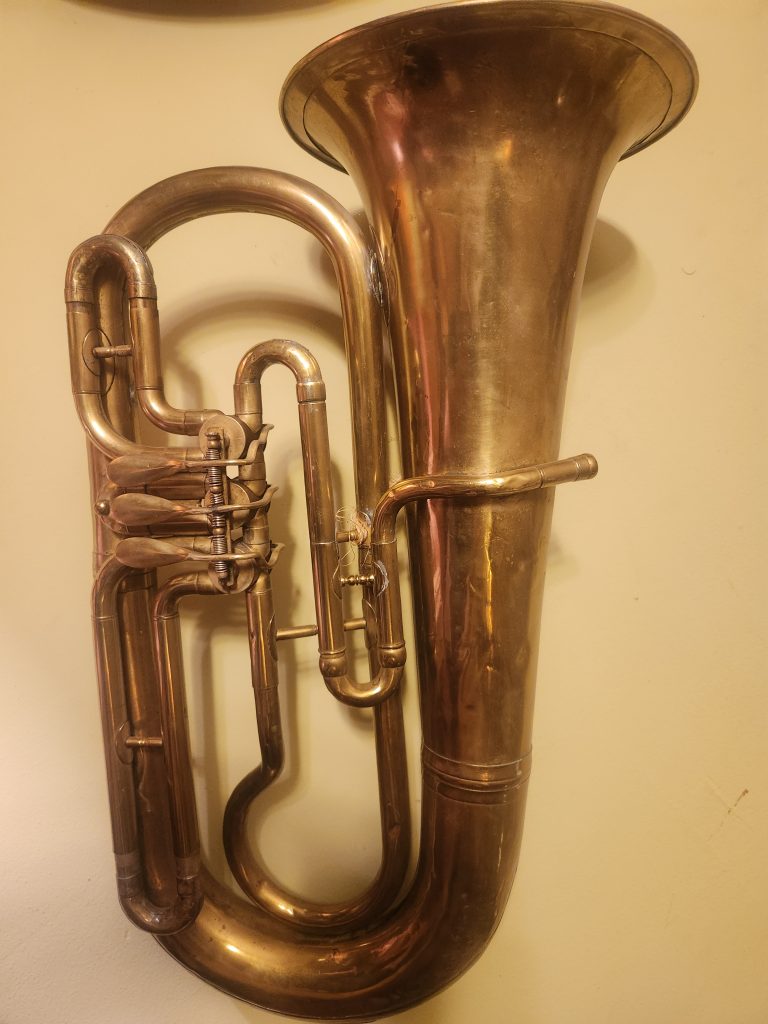
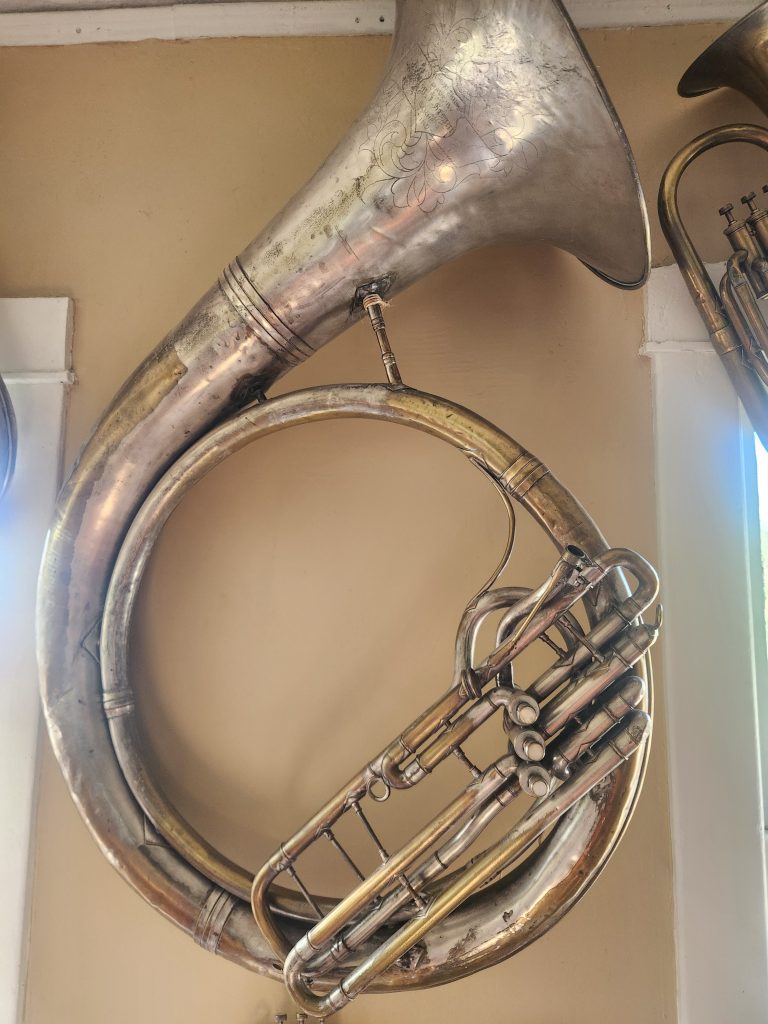
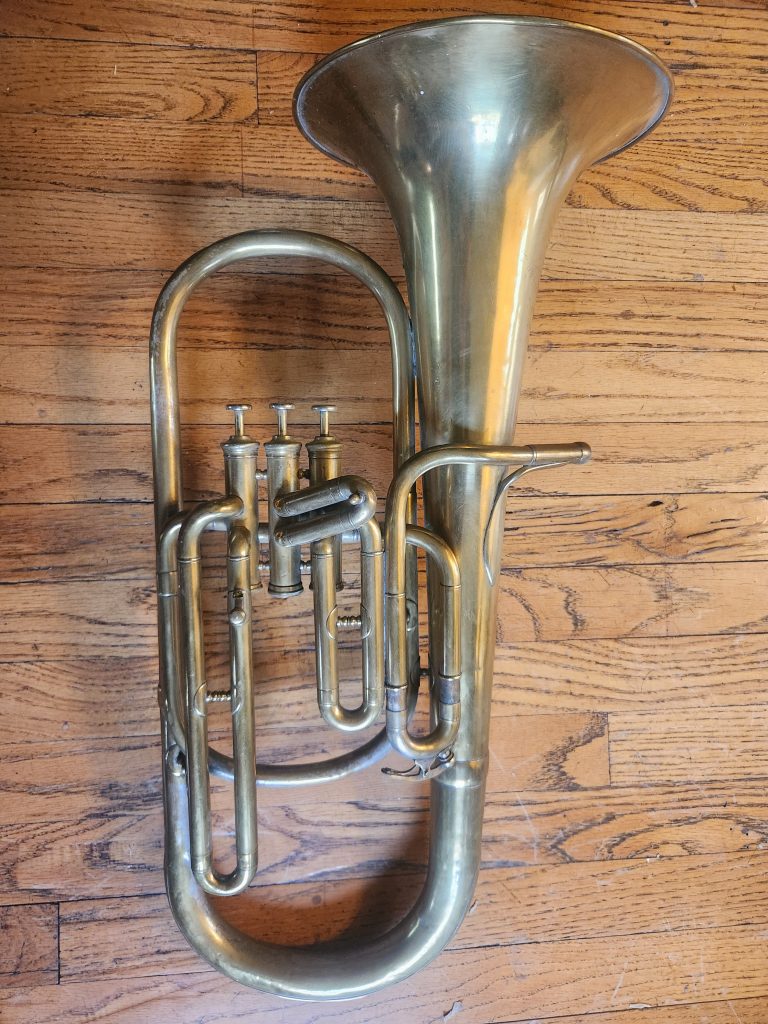
Here’s a b-flat bass helicon (predecessor of the Sousaphone).  It’s stamped “Elkhart Triumph, made by W. J. Gronert, Elkhart, Ind.”  And thereby hangs a tale, illustrating the convoluted state of early American instrument makers, in and out of business with one another.
William Joseph Gronert was born in Hastings, England in 1851, and served 9 years in the British army as a musician. In 1874 Gronert immigrated to the US and joined the 17th US Infantry as a musician. By 1880 he was a musician living in Elkhart, Indiana, and boarding with instrument maker Jacob Berkley.

After marriage and children, in 1885 Gronert joined C. G. Conn and eventually became his factory manager.  In 1911, Gronert founded the Elkhart Musical Instrument Co. In 1912, Robert Middleton patented  a trombone tuning slide device that was assigned to Elkhart; that device looks remarkably like one I have on a 1925 Conn bass trombone – I’ve no idea if it was the patented device, or if it was used with permission. In 1912, Gronert sued Conn for lack of payment, eventually settled in 1916.

The information I can find on Gronert pictures several cornets and a trumpet, including several 4-valve models, quite rare then and now.  No lower brass is noted at all. Instruments of the same design might be marked either Gronert or Elkhart Musical Instrument co.

Years back, I’d heard a rumor of a “sousaphone” hanging on the wall of a local scrap metal yard.  On checking, said firm was out of business, but some assets had been acquired by another.  On visiting, I spied the horn on the wall of the new firm, crushed and encased in grunge.  I asked the counter help if they’d sell it; was told that the owner would not – he thought it looked “neat”.  I pushed back, thinking that several hundred might pry it loose.  The reply was; “someone even offered him $50.00 for it, and the boss still would not sell.  I sent an offer back for $100.00, and closed the deal.

I dropped the horn off at a bumper re-plating firm to have it chemical dipped to remove the grunge; then to my repair tech (Bill Law, a good friend and my brass band’s bass trombonist). He had to take it apart down to the valve cluster, hammer it back into shape, and cobble it back together.  It now plays great.
J. W. Pepper E-flat Valve Trombone

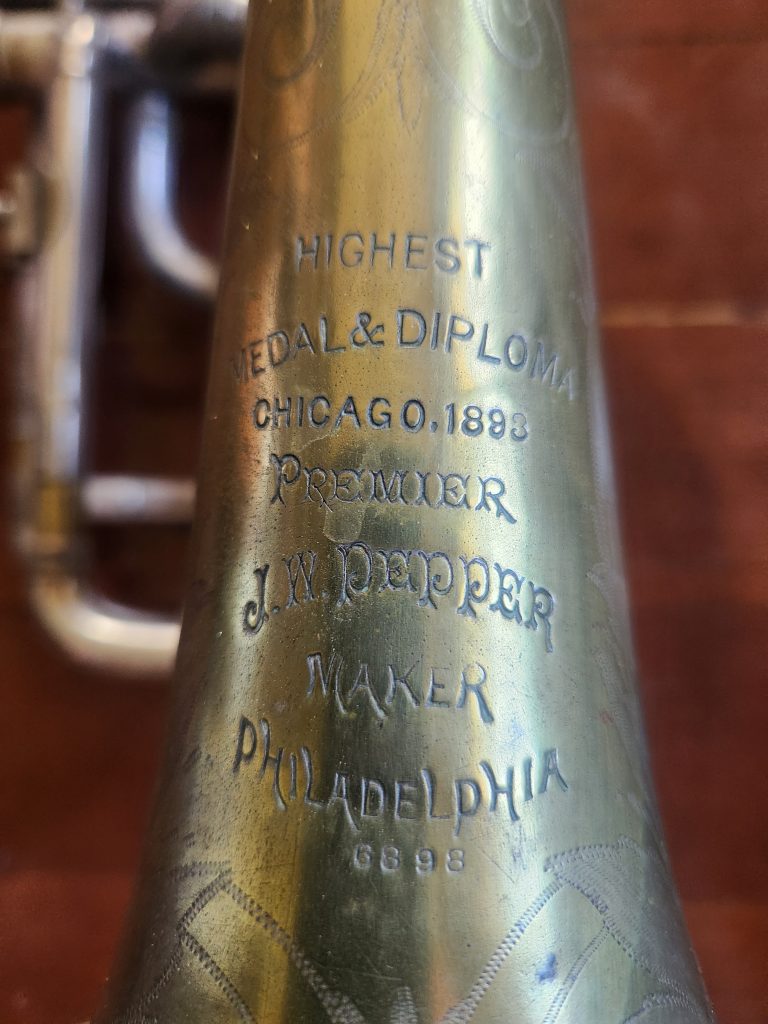
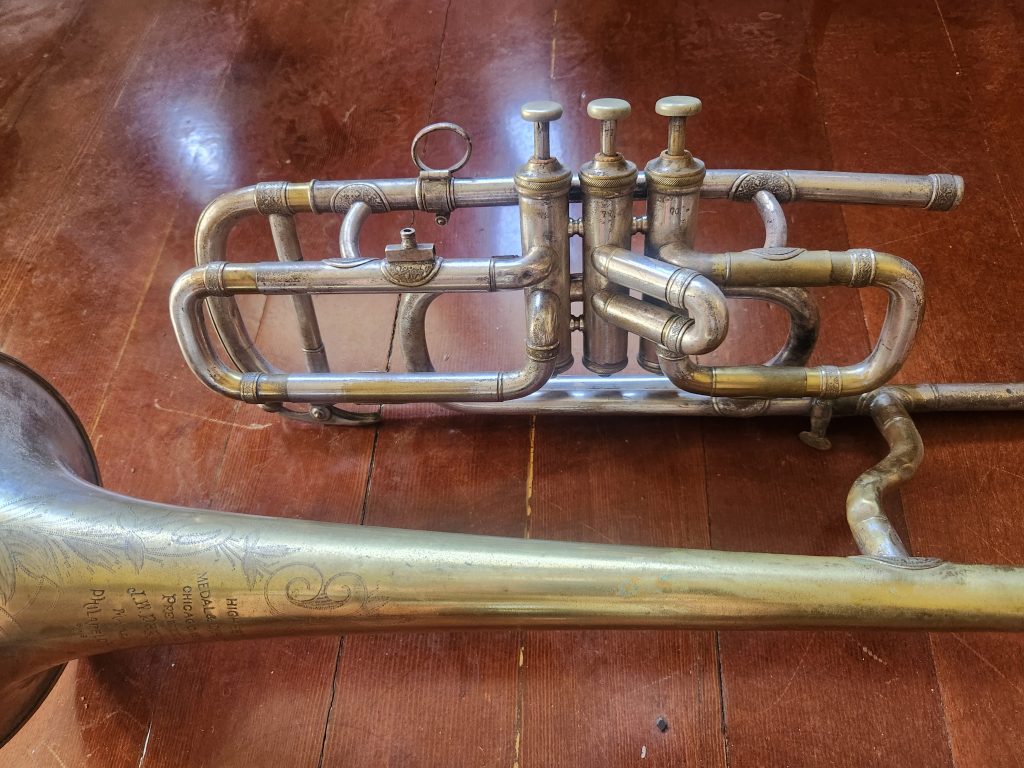
J. W. Pepper e-flat valve trombone. Three piston valves, silver plate (much worn, especially on the bell section).  The only catalogue drawing of a Pepper  e-flat I’ve run across (circa 1904) shows a longer wrap, and a rather more modern look to my eye.  My example features a short, tight wrap. The serial number indicates 1893; it’s marked as “Premier”, which Pepper seems to have used only for their own manufacture (some horns, including e-flat valve trombones, were imported and stamped with the Pepper name).

Pepper was a Philadelphia music publisher and maker of brass instruments and drums from 1876 to about 1910, when they exited instrument making and continued as a music publisher, to the current day. The instruments are of high quality and rather sought after.  Early on, Pepper employed a number of prominent folks in the industry, including Henry Distin and Slater.

Until about the turn of the century, valve trombones, both e-flat and b-flat, were more common than slide trombones.  Music of the period often shows the same music for trombones and tenor or alto horns, the divergence of writing happening, as far as I can tell, somewhere around 1900.  And a good thing; it’s hard to imagine Henry Fillmore writing “smears” for alto horn.

My Friend Ginger Maddox, RIP

Lost a good friend this Spring.  Besides our long friendship, I worked with Ginger Maddox in historic preservation issues in my old F Q Story neighborhood, and then recruited her to join our association board; I served with her until her unexpected passing.  Here’s a brief eulogy I delivered at a memorial service at the Franklin Police and Fire Academy, a first responders focused high school in our neighborhood, with which Ginger fostered our relationship:

Remembering Ginger

About noon on Friday, September 19, 2014, the FAA “permanently” redirected most of Sky Harbor’s western takeoffs (meaning most afternoon and evening departures) from over the Salt River floodplain (the route for decades), to a route over downtown Phoenix and out along Grand Avenue, creating severe noise, vibration and pollution issues over our historic neighborhoods, and most directly over Story.  Sky Harbor, the City and our historic neighborhoods had been blindsided.

Within 24 hours, longtime Story neighbors Ginger Mattox and Steve Dreiseszun were leading what became a 4 year-long effort by the Story, Roosevelt, Willow, Encanto/Palmcroft neighborhoods and others , to reverse that move. By Sunday, Ginger was already diving into Federal regulations, and picking the brains at Phoenix’s Historic Preservation office, for actionable steps.

Ginger researched regulations, legal cases, impact studies; located and collaborated with groups around the country that had dealt with similar issues; helped orchestrate town meetings, media coverage and City Council testimony; coordinated with various City and Sky Harbor offices; collected testimony from folks who had been injured by the overflights; and eventually, when persuasion failed, gathered data and testimony for our DC Circuit Court lawsuit against the FAA.  Thanks to efforts of Ginger and many others, and wonderful work by Terry Goddard’s law firm, our little neighborhoods beat the FAA – the only defeat in a similar case the FAA had suffered in some decades.

I’m not sure when Ginger got any sleep, those years.

Ginger also headed our efforts to address odor, pollution and safety issues with the asphalt and petroleum firms along the 19th Avenue rail yards, and the recycling operations along McDowell west of 19th Avenue, both bordering and impacting Story. In these, she researched and mastered a mountain of technical and regulatory issues, but also found ways to collaborate with the firms, helping to make them ongoing good neighbors, rather than bad actors for us to fight.

In these and other areas – squatter and homeless issues, preserving our historic homes, traffic calming, State Fair and other event parking, our wonderful relationship with the Franklin School – Ginger brought a rare combination of deep research ability with the ability to collaborate; not just to find a compromise, but to get all “sides” working together to find a path that would benefit all.

Ginger’s kind does not come along often.  And I cannot think of anyone who contributed as much to our community, and to our lives. She will be missed.


Fertility Decline and the University Education

Just caught Louise Perry’s excellent 5/23/2026 Wall Street Journal Op Ed “Falling Birthrates Are a Mystery”. The observation that ”…Everyone has an explanation that supports a pre-existing political position…” is provocative, as are the several explanations that are explored.

However, three potential explanations are omitted, two that are often mention and a third, rarely.

First – consider the decline in religious belief.  Beyond the oft mentioned correlation, society by society, of decline in belief and decline in births, it resonates that a lack of belief in an afterlife, and of any potential reward or punishment therein, would encourage a tendency to “party now – let the future care for itself”. There’s no good reason to endure the hardships of raising children if one has no thought for, and nothing owing to, the future.

Second – meditate on a combination of the lesser need to have children to work the farm and to support one in one’s old age, and the impact of better health.  Those farms that remain are largely mechanized, so children are no longer needed to work; Social Security and job pensions take on one’s old age support. Further, back when many children died of infection or poor sanitation, one needed more children to insure that a few remained.  Vaccination and clean water supplies have cut the number of children one needs that a few might survive.

Third – Not mentioned is the deleterious effect of the rising popularity of university education, at least in America and similar cultures.  Generations ago, kids married soon after high school, and quickly began producing children. They married someone met in high-school, church, or neighborhood – all local.  They (generally the husband) took a job locally; they continued to live locally.  Thus, a robust local support network was in place for early marriage “on a shoe string”, and for raising children.  Usually both sets of grandparents were present nearby (and young enough to be useful, as they had had their kids early), as well as aunts, uncles, cousins, and church and neighbor relationships going back years.  Not only was expensive childcare (mentioned in the article) not needed, but Grandma’s attic likely contained an old crib, a starter bicycle, toys, outgrown clothes. Further, folks were available to cook the occasional meal, walk the first-grader to school, loan a twenty, and much more.

When kids go away to college, they meet kids from across country, marry them, and cannot set up house near both extended families.  They delay marrying, and especially having kids, for the years of college, and often more years to establish themselves in the chosen profession (often in a city new to the both of them, and bereft of family and other support).  Following their example, many non-college bound kids are encouraged to delay having kids, so as to “explore themselves”, as well. The longer one delays having that first kid, the fewer kids one will have.

D. C. Hall B-flat Bass

An unsigned horn in B-flat (same pitch as a modern trombone or euphonium). An 1879 D. C. Hall catalogue shows an identical horn identified as a B-flat bass, alongside two very similar horns listed as baritone and tenor in B-flat; the horns were classed according to the degree of comicalness rather than the modern practice of classifying by pitch.  It is original save for the tubing from the mouthpiece receiver to the valve cluster, likely to accommodate a conversion to lengthen the tubing to modern “low” pitch – a longer tuning slide, the simplest conversion, would have run into the bell. It plays wonderfully, with an “Irish tenor” sound when used with a large euphonium mouthpiece (a Schilke 52E2) with a tenor trombone shank. The quick, short throw valves are a delight.
In his Allen, Hall & Quinby Instruments, Robb Stewart shows a close to identical B- bass dating to 1858.  D. C. Hall, J. L. Allen and the Quinby brothers were early Boston makers, in and out of business with one another. Here’s an excerpt from Robb’s description:

“This was a time of great creativity among the early US makers, greatly influenced by European designs, but almost always in a uniquely American style.   Improvements were constantly being made acoustically and ergonomically.  Of the three designs pictured here, these are the most comfortable to hold in playing position.  Compared with top action levers, the arc of the lever is much more shallow, giving the finger tips the feeling that they are pushing it straight down rather than following the arc.  The same design was soon applied to cornets and there too, became the dominant style among Boston makers and the less expensive European copies made for the US market.  The two earliest cornets of this style that I know of were made later but before 1862: a D.C. Hall cornet in C in the Brussels MIM and Eb sopranos by Isaac Fiske that are featured on this site.

“The “Allen” valves with flat windways as seen in the photo below also add to the playing ease.  The levers only move slightly more than 1/4″ with a very light touch.  This was the main goal of this design and it works very well indeed.”

Penzel-Muller Baritone

Penzel-Muller was established in New York City in the 1890, by two German immigrants, and had a long and successful run producing clarinets to compete with the finest imports.  The firm seems to have never manufactured brass instruments; those labeled Penzel-Muller were unlabeled imports stamped by the firm.  The current example likely was made between 1899 and 1916.

It is in high pitch with a tenor trombone shank; the sound is close to a modern British baritone.  Good original condition with tight valves, but little of the original silver plate remains.

“Just a Housewife”

Over the centuries and across many cultures, we males (aka “the patriarchy”) have sold to gals a marvelously self serving narrative, perhaps best summarized in the saw “she had not the ambition or talent to forge a career; she’s just a housewife”.

Though details vary, most cultures organize labor sharing within the household by distinguishing the “breadwinner” from “the homemaker”. The breadwinner works aggressively to bring home sustenance; the homemaker, primarily, brings up the kids.

Which of the two is the more important, and the more difficult?

Through a variety of lenses, from survival of the species to survival of society, the homemaker is primary. A new generation needs be created and formed to itself form the following generation, without which both species and society vanish. The breadwinner, while important, is the supporting role, and also the less difficult. Few jobs are as complex, nor as unremitting, as successfully raising a kid, let alone several. Breadwinner flees the house each morning not so much to please his boss as to escape the screaming kids.

Should gals ever tumble to reality, they’ll speak of “she wasn’t up to being a housewife; she had to settle for a career instead”. And we males will no longer be allowed to reserve for ourselves the better paying, and more prestigious, careers.

In passing, there seems some reason for the traditional assigning of roles by gender. Offing the mammoth requires aggressiveness and some disregard for personal safety; forming the kids requires empathy. If the folks who advocate for more gals in the executive suite and in the legislature, because they possess a different skill set (empathy), are correct, the traditional rolls society assigns make some sense.

Back To Top