D. C. Hall B-flat Bass
An unsigned horn in B-flat (same pitch as a 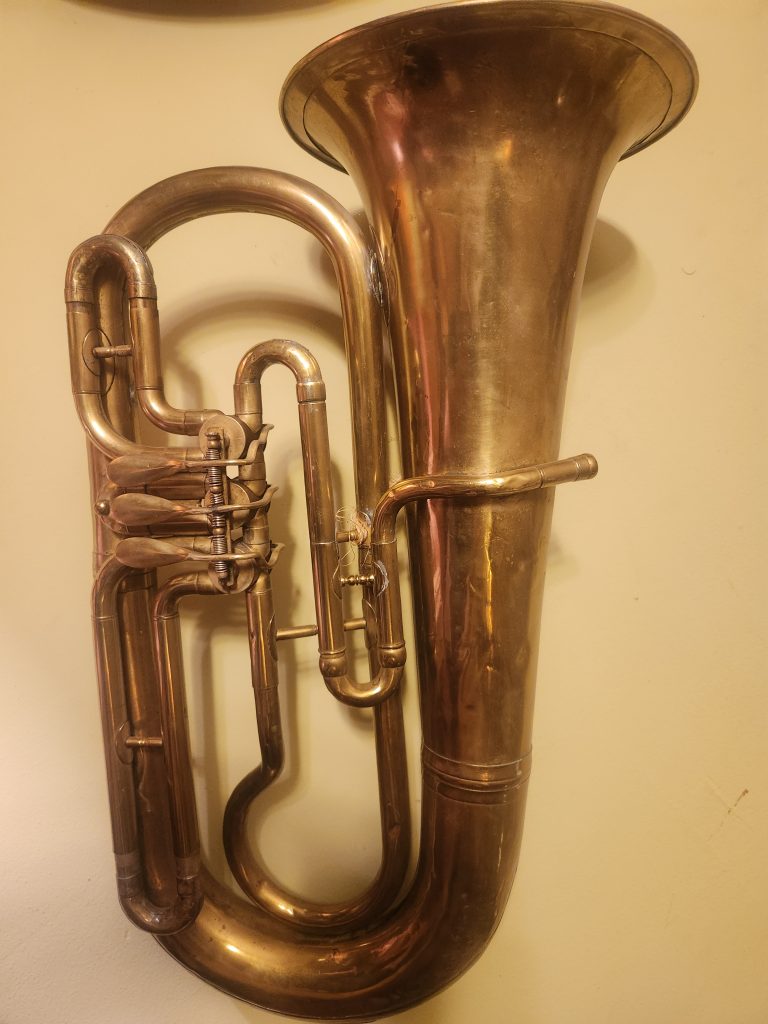 modern trombone or euphonium). An 1879 D. C. Hall catalogue shows an identical horn identified as a B-flat bass, alongside two very similar horns listed as baritone and tenor in B-flat; the horns were classed according to the degree of comicalness rather than the modern practice of classifying by pitch. It is original save for the tubing from the mouthpiece receiver to the valve cluster, likely to accommodate a conversion to lengthen the tubing to modern “low” pitch – a longer tuning slide, the simplest conversion, would have run into the bell. It plays wonderfully, with an “Irish tenor” sound when used with a large euphonium mouthpiece (a Schilke 52E2) with a tenor trombone shank. The quick, short throw valves are a delight.
In his Allen, Hall & Quinby Instruments, Robb Stewart shows a close to identical B- bass dating to 1858. D. C. Hall, J. L. Allen and the Quinby brothers were early Boston makers, in and out of business with one another. Here’s an excerpt from Robb’s description:
“This was a time of great creativity among the early US makers, greatly influenced by European designs, but almost always in a uniquely American style. Improvements were constantly being made acoustically and ergonomically. Of the three designs pictured here, these are the most comfortable to hold in playing position. Compared with top action levers, the arc of the lever is much more shallow, giving the finger tips the feeling that they are pushing it straight down rather than following the arc. The same design was soon applied to cornets and there too, became the dominant style among Boston makers and the less expensive European copies made for the US market. The two earliest cornets of this style that I know of were made later but before 1862: a D.C. Hall cornet in C in the Brussels MIM and Eb sopranos by Isaac Fiske that are featured on this site.
“The “Allen” valves with flat windways as seen in the photo below also add to the playing ease. The levers only move slightly more than 1/4″ with a very light touch. This was the main goal of this design and it works very well indeed.”