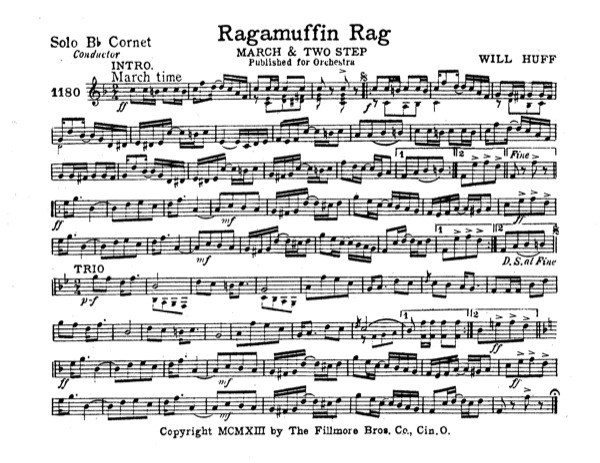
 Played euphonium Friday night in a concert with the Phoenix Pioneer Band, a re-creation of the turn of the century Phoenix town band. We opened with a rag, credited to Will Huff, and published by Fillmore brothers. And there-in hangs a tale.
Henry was the son of one of the two Fillmore brothers, a firm of religious music publishers in Cincinnati. As a youth, Henry mastered piano and violin, and then the slide trombone. His religious family tried to wean him from the trombone, viewed in the day as an instrument of the Devil – it was prominent in the music of dives, honky-tonks, and places not mentioned in polite company. Henry was not to be dissuaded, continuing with the trombone and eventually doubling down: he took up with an exotic dancer, and together they ran away to the circus, Henry playing trombone and soon conducting and composing music for the circus band, and the dancer…. dancing.
Eventually, Henry and family reconciled; he and the exotic dancer (now his wife) moved back home, and Fillmore Brothers published an extraordinary volume of Henry Fillmore compositions. So many compositions, in fact, that Henry used at least nine pseudonyms to avoid suspicions of his trying to corner the market.
One of those pseudonyms was Will Huff.
Then, Henry chanced to meet the real Will Huff, who turned out to be himself a musician and band composer, living nearby and published by a rival house in Henry’s own Cincinnati. One imagines a somewhat awkward conversation. Seemingly, they worked it out, for Fillmore Brothers soon began publishing music by Will Huff as well.
So when one encounters music by Will Huff, published by Fillmore Brothers, one might not know for sure who wrote it.
(If this isn’t arcane enough for you, the one-time E-flat tuba with the Brass Band of Columbus, Paul E. Bierley, authored (after much research) The Music of Henry Fillmore and Will Huff, as well as Hallelujah Trombone!, a biography of Henry. Paul sorts much of it out.)
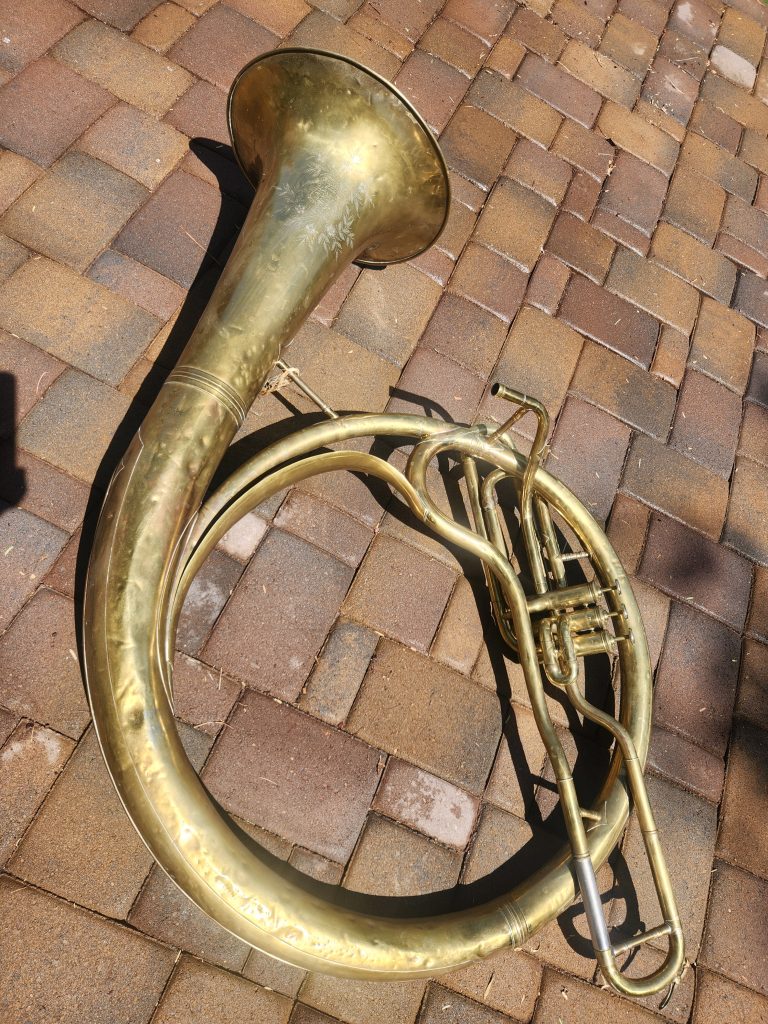
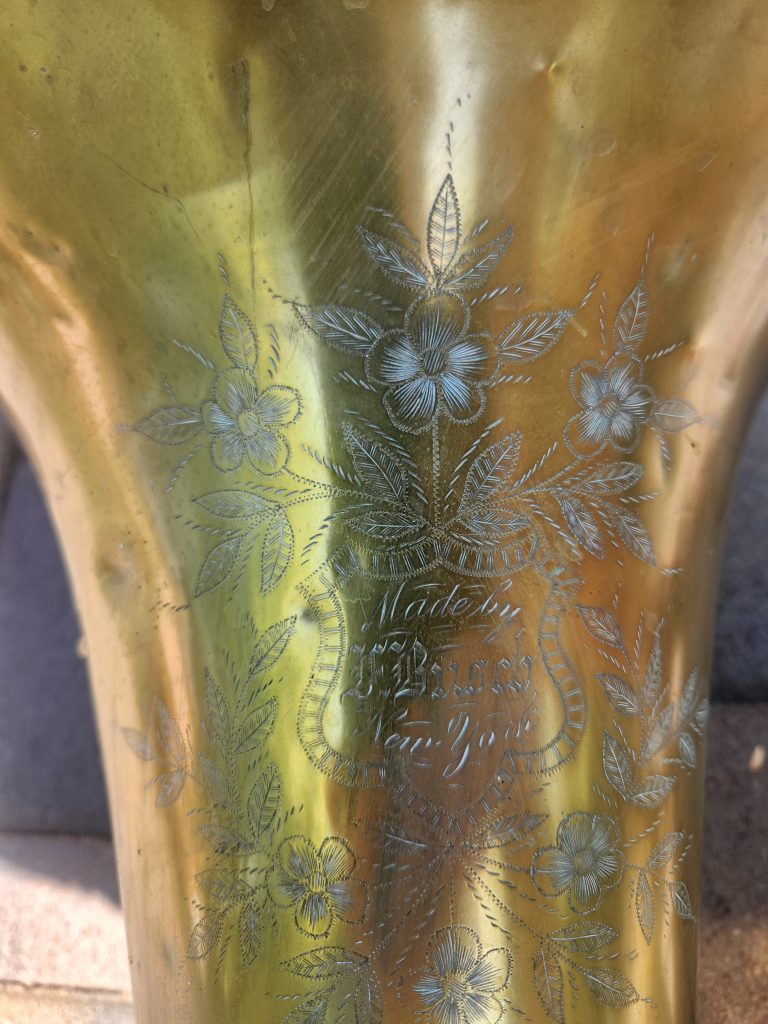
 John Howard Foote, a Connecticut boy, began an instrument business in New York City in 1857, with various partners, including J. F. Stratton; in 1864 the firm was Stratton & Foote…importers & manuf of musical instruments. In 1868 Foote added a Chicago store.
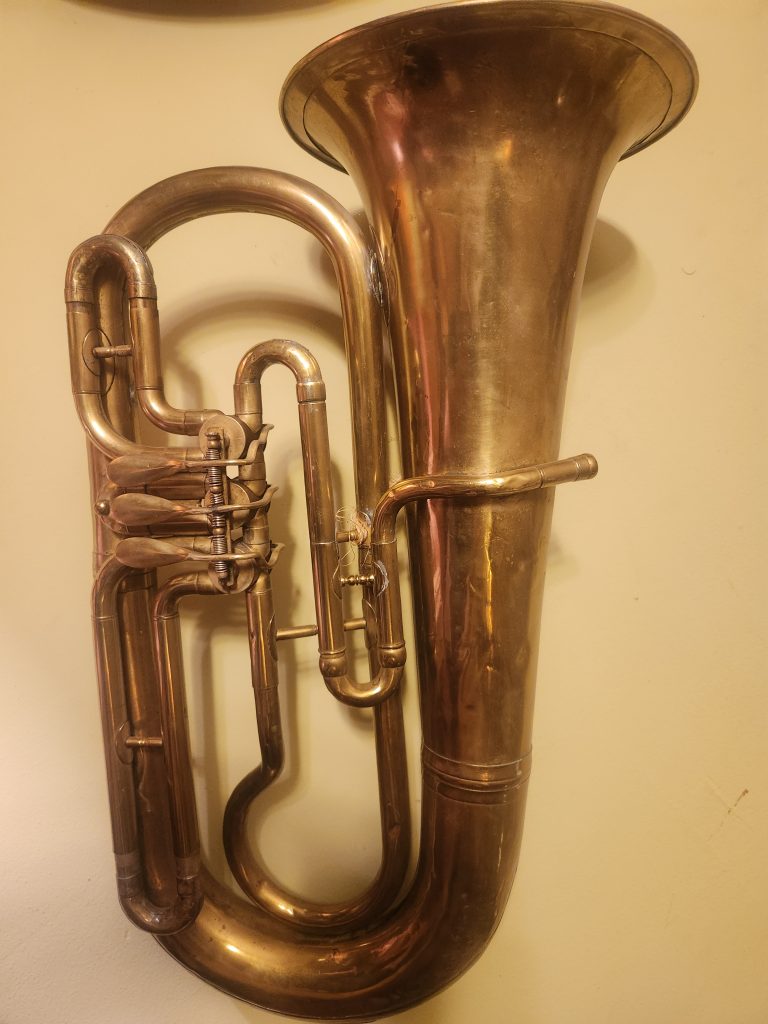
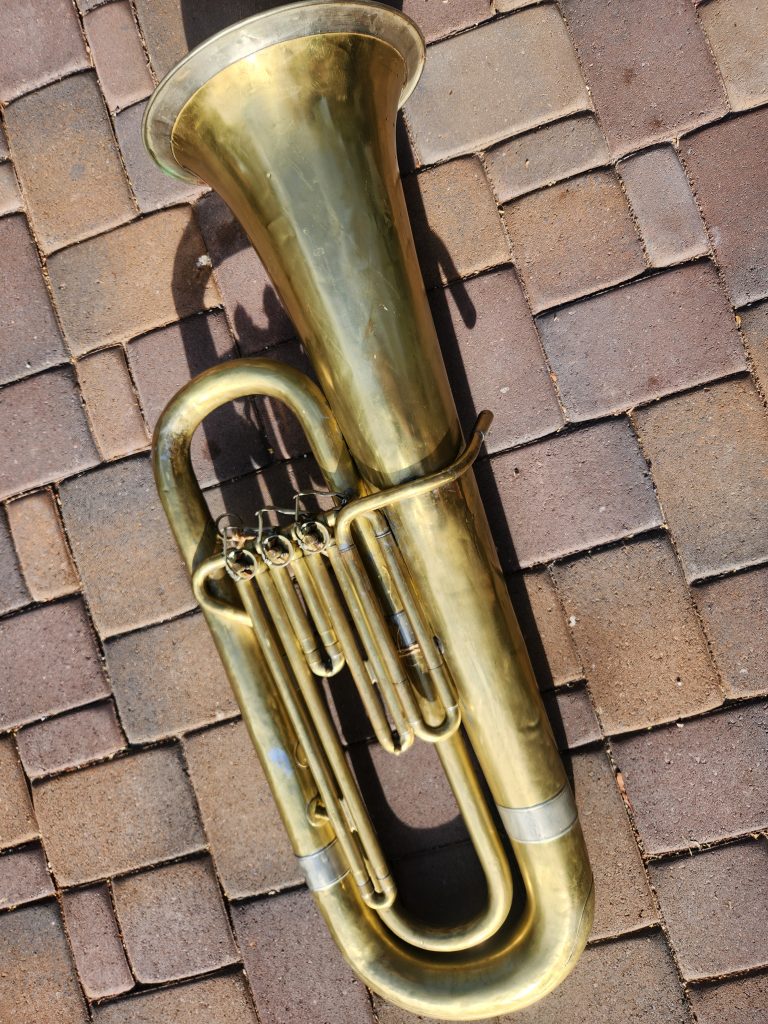 A top action, string rotary valve e-flat tuba, remarkably conical with a large throat and small bell, producing a rich sound. A tiny stamp on the bell reads ”Seefeldt Musical Inst. Manuf. Co., Philadelphia“. I cannot find enough of a serial number list to give any indication of date of manufacture.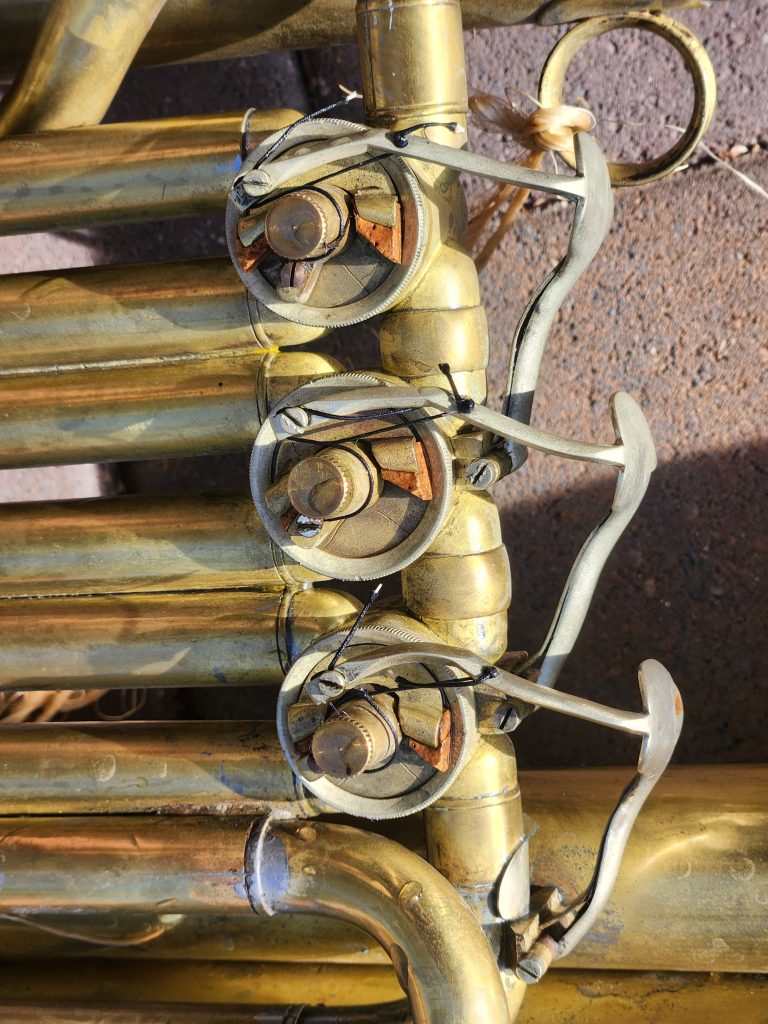
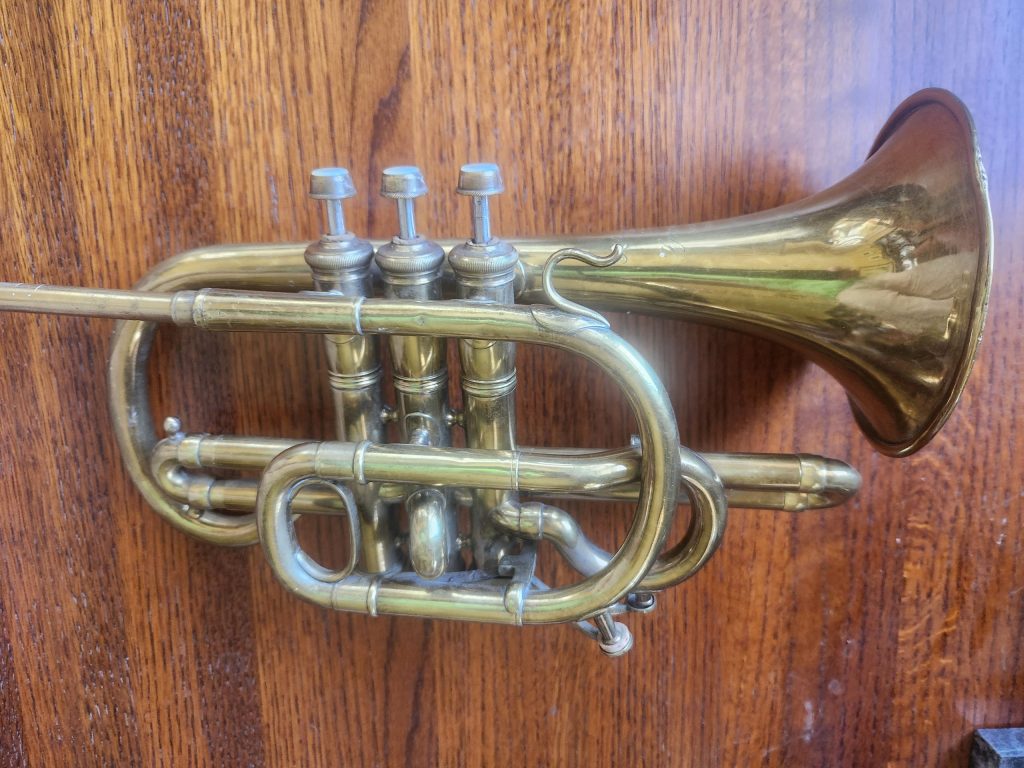 . The 1896 Lyon & Healy catalogue lists it with picture, likely with French piston valves.
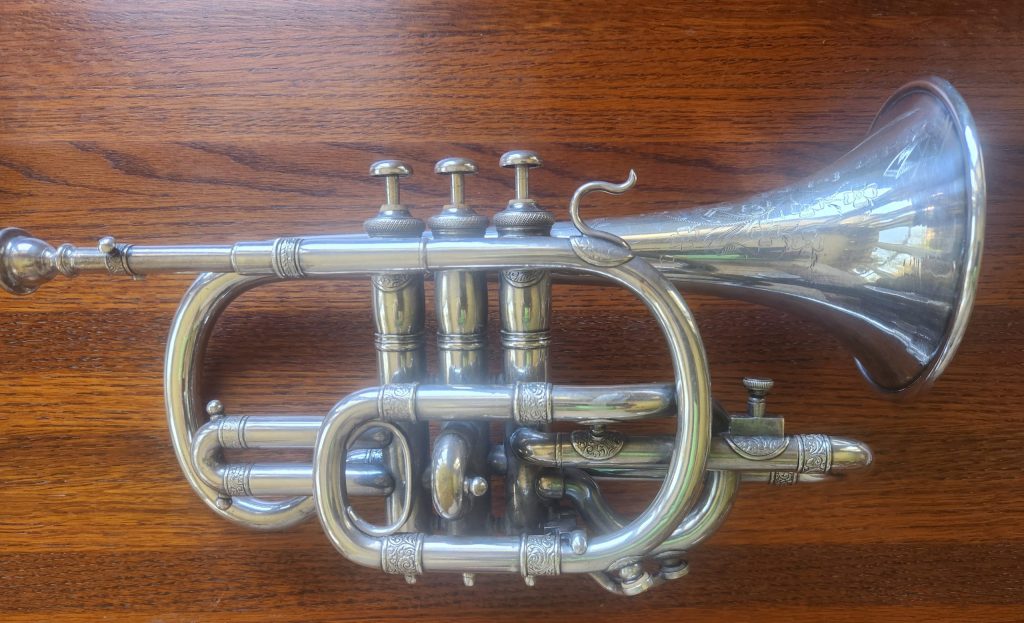 Beautiful B-flat cornet, stamped Beau-Ideal, Chicago. Beau-Ideal was a trade name used by Lyon & Healy for their French imports, I understand generally the ones of higher quality. Silver plate is intact save for a bit of wear at the end of the second valve slide. Dual water keys and an aggressive shepherd’s crook; ornate engraving on mounts and bell. Intact and original. No serial number.
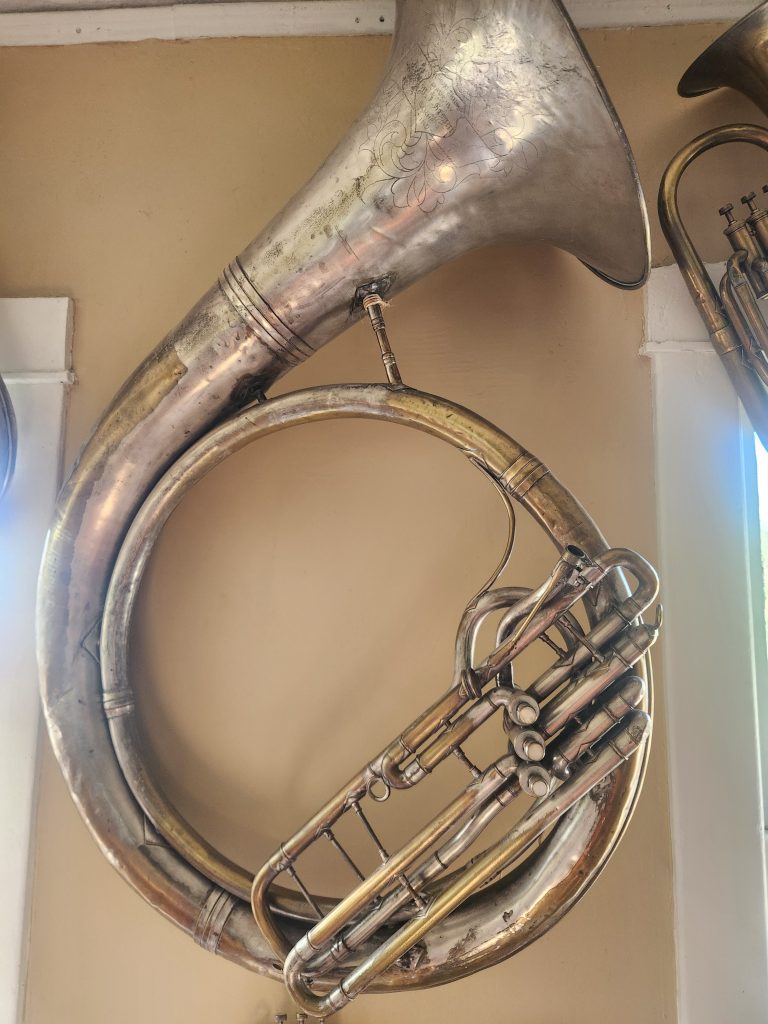 Sousaphone). It’s stamped “Elkhart Triumph, made by W. J. Gronert, Elkhart, Ind.” And thereby hangs a tale, illustrating the convoluted state of early American instrument makers, in and out of business with one another.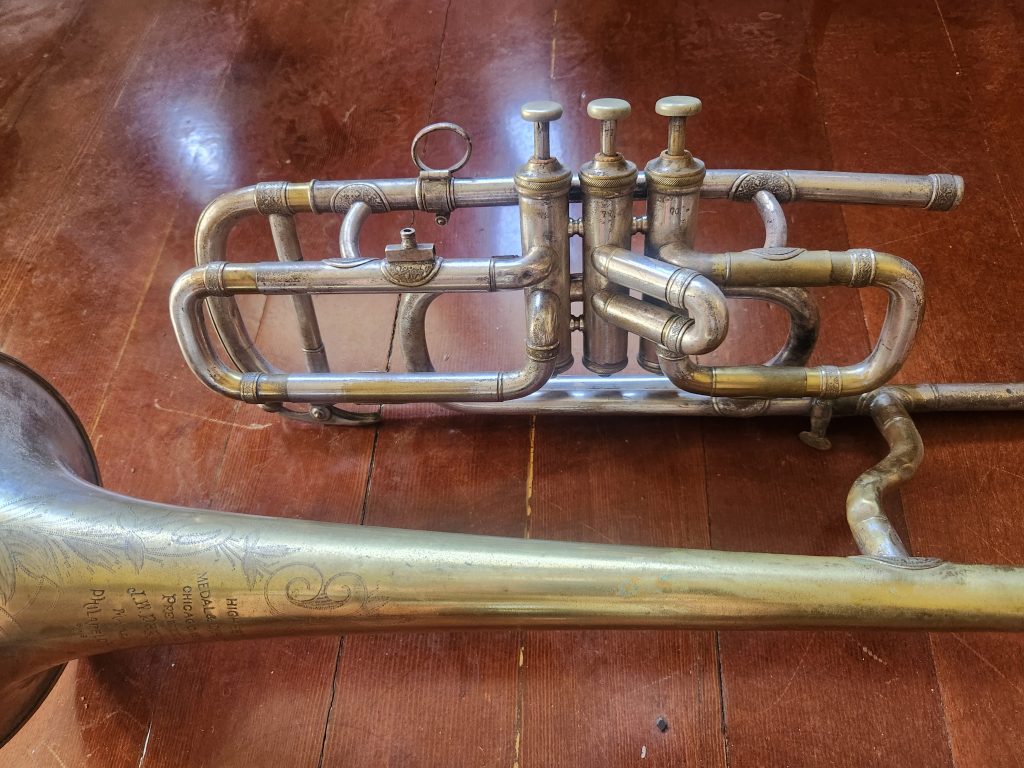
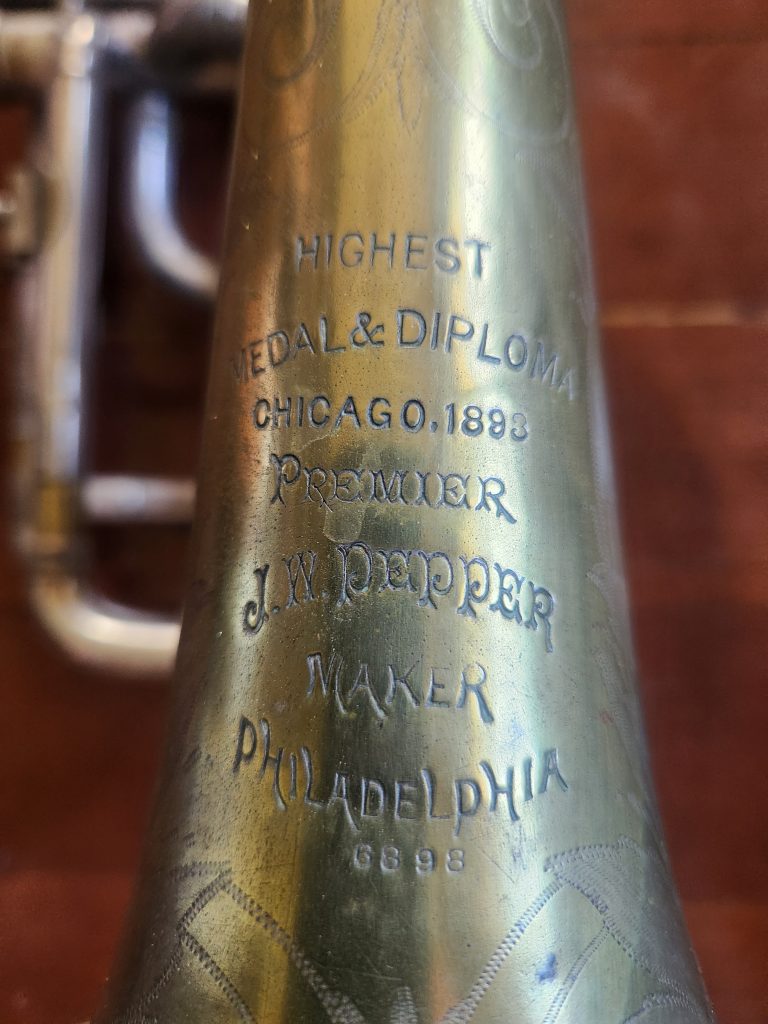
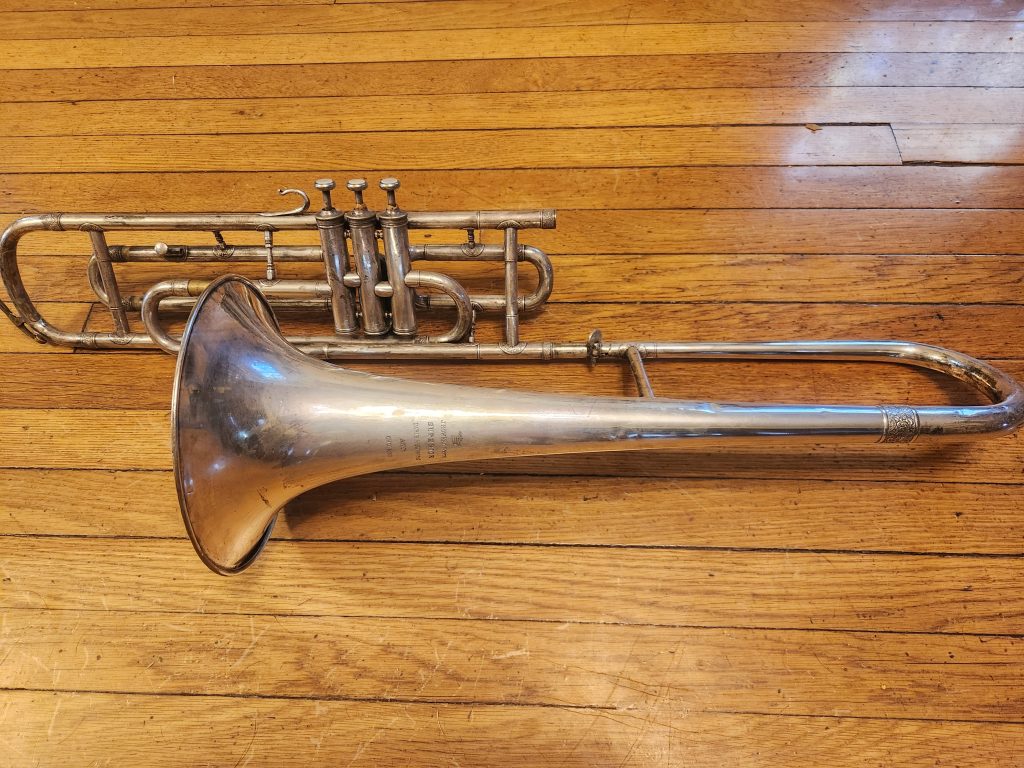
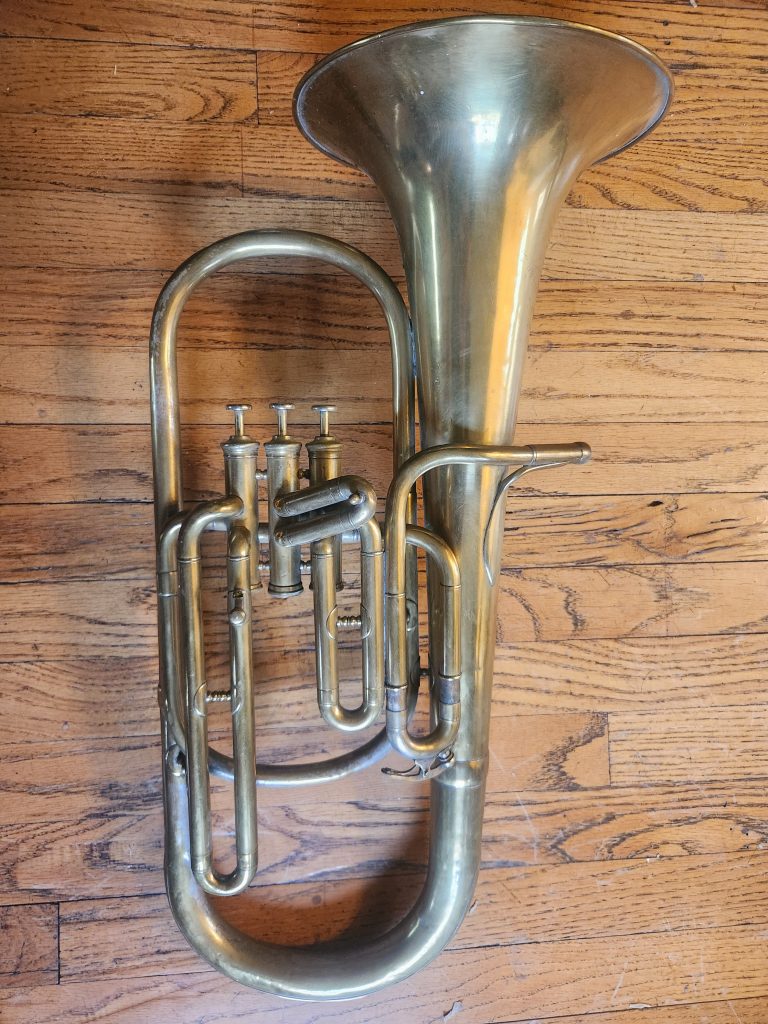
 modern trombone or euphonium). An 1879 D. C. Hall catalogue shows an identical horn identified as a B-flat bass, alongside two very similar horns listed as baritone and tenor in B-flat; the horns were classed according to the degree of comicalness rather than the modern practice of classifying by pitch. It is original save for the tubing from the mouthpiece receiver to the valve cluster, likely to accommodate a conversion to lengthen the tubing to modern “low” pitch – a longer tuning slide, the simplest conversion, would have run into the bell. It plays wonderfully, with an “Irish tenor” sound when used with a large euphonium mouthpiece (a Schilke 52E2) with a tenor trombone shank. The quick, short throw valves are a delight.
 Penzel-Muller was established in New York City in the 1890, by two German immigrants, and had a long and successful run producing clarinets to compete with the finest imports. The firm seems to have never manufactured brass instruments; those labeled Penzel-Muller were unlabeled imports stamped by the firm. The current example likely was made between 1899 and 1916.